

The Big Welcome
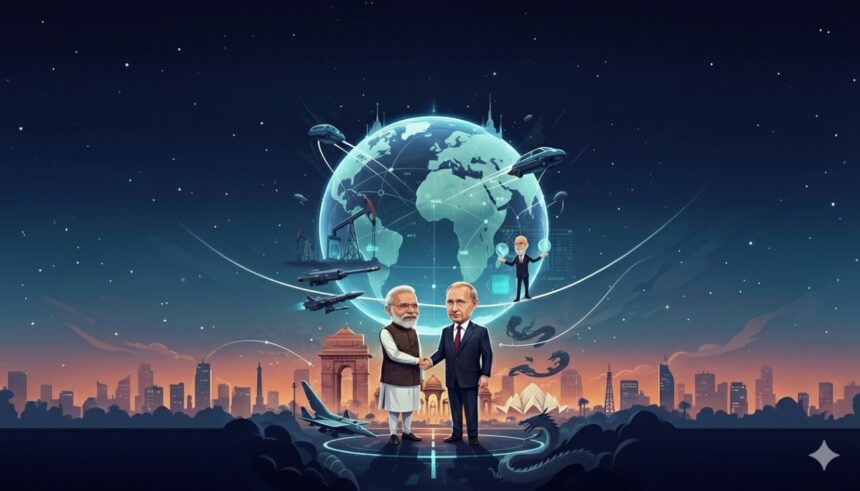
So, Vladimir Putin touched down in Delhi. One might even say, an event pregnant with unspoken implications. It is, after all, his first tangible foray onto foreign soil since the conflagration in Ukraine ignited back in early ’22. Mark the date: December 4th and 5th, 2025. This is not merely a social call.
Consider this the 23rd India-Russia Annual Summit, a ritual of diplomacy heavy with history. It speaks volumes about the “special and privileged strategic partnership” these two nations have nurtured. The real question isn’t just that he’s here, but why now, at this precise inflection point in global affairs. What are the subtle currents flowing beneath the surface of diplomatic pleasantries?
A Friendship Forged in Time
This isn’t a recent dalliance; the roots run deep. Back in 1947, during the nascent years of Indian independence, an affinity bloomed between India and the Soviet Union. They became Cold War allies, a bond cemented by the 1971 Treaty of Peace, Friendship, and Cooperation. A strategic embrace born of shared geopolitical perspectives.
When the monolithic USSR dissolved, a lesser observer might have predicted the relationship’s demise. Yet, Russia and India managed not only to sustain the flame but to intensify it. In 2010, they formally upgraded their connection to a “Special and Privileged Strategic Partnership,” a testament to enduring commitment in a world of fleeting allegiances.
The foundation of this relationship has always been multifaceted. The relationship covers defense, politics, nuclear energy, counter-terrorism, and even the vast expanse of space exploration. For decades, Russia has essentially served as India’s primary arms supplier, a critical component of India’s strategic calculus.
The Global Chessboard: Why This Visit Matters Right Now
The elephant in the room – Ukraine. The war casts a long shadow, and the West’s concerted efforts to isolate Russia give this visit an undeniable significance. It is a carefully choreographed act on a global stage, a defiant counterpoint to Western pressure.
India finds itself navigating a complex terrain. It cherishes its historical ties with Russia, yet simultaneously cultivates increasingly close relationships with the United States and Europe. This balancing act is often described as “strategic autonomy” – a principle by which New Delhi charts its own course, guided by its own national interests.


From Moscow’s perspective, this visit is a potent symbol. It is a signal to the world that Russia is far from isolated, that it maintains robust relationships beyond the confines of the Western sphere of influence.
What’s on the Agenda? Deals, Dreams, and Diplomatic Dances
Anticipate extensive discussions on defense cooperation. This includes finalizing the deliveries of the S-400 air defense systems and potentially even exploring a joint venture for the advanced Su-57 fighter jet. India’s continued reliance on Russian military technology underscores the importance of this sector in the bilateral relationship.
Economic considerations are also paramount. The ambitious target of reaching $100 billion in bilateral trade by 2030 will undoubtedly be a key focus. India seeks to diversify its exports to Russia, moving beyond primarily importing oil and weaponry to include pharmaceuticals, agricultural products, and other goods.
Energy security remains a vital area of cooperation. India has benefited significantly from discounted Russian oil, and discussions will likely encompass long-term oil supply agreements and potentially even the development of small modular nuclear reactors.
Beyond the headline-grabbing deals, expect conversations encompassing healthcare, education, culture, and even facilitating the movement of skilled Indian workers to Russia.
The Controversy Corner: Who’s Happy, Who’s Not?
Unsurprisingly, the West views this visit with considerable unease. The United States has already imposed tariffs on India, arguing that its purchases of Russian oil indirectly fund the war in Ukraine. Moreover, a joint op-ed penned by European envoys criticizing Russia drew sharp rebuke from India, which deemed it “unacceptable interference.”
India’s response has been unwavering: it asserts its right to conduct an independent foreign policy, free from external dictation. India is not a signatory to the International Criminal Court (ICC), the arrest warrant issued for Putin holds no sway.
Even China, Russia’s “no-limits” partner, observes this engagement with keen interest. Beijing harbors some reservations about India acquiring advanced Russian military technology, viewing it as a potential counterbalance to its own strategic ambitions. Furthermore, Russia itself sometimes sees India as a counterweight to China’s growing influence.
Domestically, the visit has not been without its detractors. Some opposition leaders have criticized the government for failing to involve them in such a strategically significant international engagement.
Peering into the Future: What’s Next for This Power Couple?
India’s gradual diversification of its defense suppliers is an undeniable trend. Yet, Russia is unlikely to vanish from the picture entirely. The focus will likely shift towards greater joint production and technology transfer, moving beyond a purely transactional “buyer-seller” dynamic.
Efforts to shield bilateral trade from the reach of Western sanctions will be crucial, potentially through the establishment of alternative payment mechanisms, such as a rupee-ruble system. Addressing India’s substantial trade deficit with Russia will also be a pressing concern.
Both nations share a vision of a multipolar world, one where power is more diffusely distributed. India’s “multi-alignment” strategy, characterized by engagement with multiple global players, appears to be firmly entrenched.
Looking ahead, expect increased cooperation in civil nuclear energy, space exploration, and a broader array of goods and services.
The Enduring Embrace (or, It’s Complicated!)
In essence, Putin’s visit transcends a mere symbolic gesture. It is a clear assertion that the India-Russia partnership exhibits a structural resilience that defies the prevailing global turbulence. It is a relationship laden with complexities and subject to controversy, but one that is unlikely to dissipate anytime soon. India needs Russia, and Russia needs India, in this constantly evolving global order. The tango continues, even as the music changes. GBN