






The Big News: What’s the Buzz About?
Heard the whispers rustling through the financial district? A subtle shift in the tectonic plates of India’s economy? The Reserve Bank of India (RBI) just concluded its Monetary Policy Committee (MPC) deliberations (December 3-5, 2025), and the pronouncements emanating from Mint Street could ripple outwards, affecting everything from the price of your next home to the expansion plans of multinational corporations.
The crux of the matter? India’s central bank has decided to gently nudge the economic gears with a carefully calibrated adjustment. The underlying sentiment? A palpable optimism about the trajectory of the Indian economy. One might even venture to suggest that we are entering a “Goldilocks period” – that elusive state of economic equilibrium where growth is neither scorching nor frigid, but just…right.
The Nitty-Gritty: Unpacking the RBI’s Decisions
Let’s delve into the specifics, shall we? The headline is undoubtedly the reduction of the repo rate.
- The Big Cut: The repo rate has been trimmed by 25 basis points (bps), settling at 5.25%. This marks the lowest level witnessed in over three years, a testament to the evolving macroeconomic landscape.
- Quick Explainer: For those less familiar with financial jargon, a “basis point” is simply one-hundredth of a percentage point (0.01%). These small increments can have significant cumulative effects.
- Keeping it “Neutral”: The RBI has maintained its “neutral” stance. It is not a passive posture, but a dynamic one, signifying a willingness to respond decisively to incoming economic data, be it benign or turbulent.
- A Year of Cuts: This isn’t an isolated event but the culmination of a consistent easing trend. This marks the fourth reduction in the repo rate this year, totaling an impressive 125 bps.
- Crystal Ball Gazing: The RBI has also updated its projections for the upcoming fiscal year (FY26), painting a picture of cautious optimism.
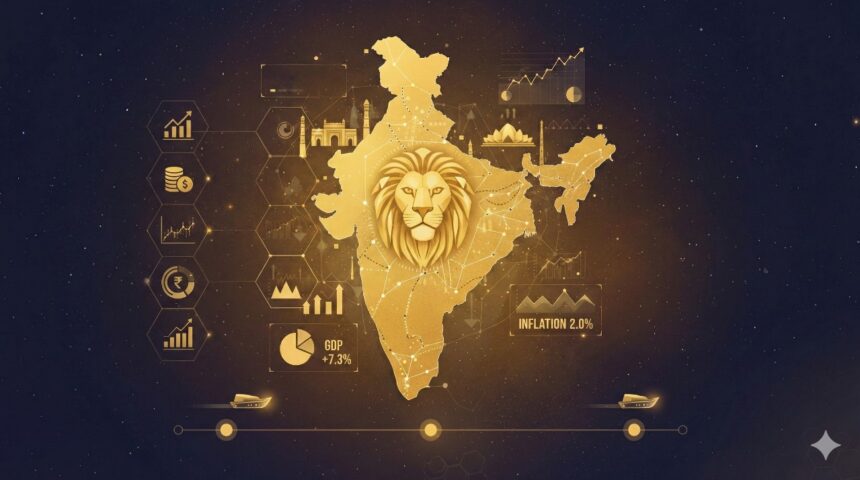
- GDP Growth: Upgraded to a robust 7.3% (from 6.8%), suggesting that India’s economic engine is indeed gathering momentum.
- Inflation: Sharply lowered to a remarkably subdued 2.0% (from 2.6%), indicating that inflationary pressures are, for the moment, well-contained.
A Walk Through Time: RBI’s Economic Balancing Act
To fully appreciate the significance of this latest move, one must consider the broader historical context. The RBI’s monetary policy stance has been anything but static.
- From Panic to Prudence: Recall the tumultuous days of 2020, when the pandemic cast a long shadow over the global economy. The RBI, like central banks worldwide, adopted an “accommodative” stance, slashing rates to stimulate demand and prevent a catastrophic collapse.
- The Inflation Fight: Then, the pendulum swung in the opposite direction. Geopolitical tensions and supply chain disruptions fueled a surge in inflation. Between May 2022 and early 2023, the RBI embarked on a tightening cycle, hiking rates aggressively to rein in runaway prices through a stance of “withdrawal of accommodation.”
- Finding Stability: By late 2024, as inflationary pressures began to moderate and economic stability returned, the RBI transitioned to its current “neutral” stance, laying the groundwork for the current easing cycle. This latest rate cut, therefore, is not a sudden departure but rather the logical progression of a carefully calibrated strategy.
Reading the Room: What Are the Experts Saying?
What does the chattering class of economists and market analysts make of all this?
- Cheers All Around: The general consensus appears to be one of cautious approval. Many economists view the rate cut as a judicious maneuver, capitalizing on the benign inflation environment to provide a fillip to economic growth.
- Good News for You! This translates into potentially lower interest rates on home loans and car loans, providing a boost to sectors such as real estate and automobiles.
- The Cautious Crew: However, a note of caution is also being sounded by some quarters.
- “Is This the Last Dance?”: Some are suggesting that this may be the final rate cut in the current cycle, with a potential pause anticipated in 2026 as the central bank assesses the impact of its recent actions.
- Global Headwinds: The specter of global uncertainties, such as the potential for renewed trade tensions (particularly with the US), continues to loom, potentially dampening India’s growth prospects.
- Market Impact: The effectiveness of the rate cut in stimulating the stock market may be limited if retail liquidity remains constrained.
Looking Ahead: What’s Next on the Economic Horizon?
The RBI’s “neutral” stance underscores the data-driven nature of its policy approach.



- Data-Dependent Dance: The central bank will be closely monitoring a range of economic indicators before making its next move.
- More Cuts Coming?: Some analysts are tentatively forecasting another 25 bps rate cut as early as February 2026, contingent on inflation remaining comfortably within the RBI’s target range.
- Boosting the System: The RBI is also actively managing liquidity in the banking system through open market operations, endeavoring to ensure that credit flows smoothly and cheaply.
- India’s Bright Future: International organizations, including the IMF and Moody’s, project India to be among the fastest-growing major economies in the world in the coming years, driven by robust domestic demand, a thriving manufacturing sector, and rapid digitalization.
- Watch Out For: The performance of the Indian rupee, which has been hovering near record lows, and the evolving global trade landscape will be crucial factors to monitor.
The Bottom Line for You:
- This rate cut presents a favorable environment for borrowing and investing. Keep a close watch on loan rates!
- The Indian economy exhibits underlying strength, but the RBI’s “neutral” stance implies the need for continued vigilance and adaptability.
- The next MPC meeting (Feb 4-6, 2026) promises to be another key event, offering further insights into the RBI’s policy intentions. GBN