




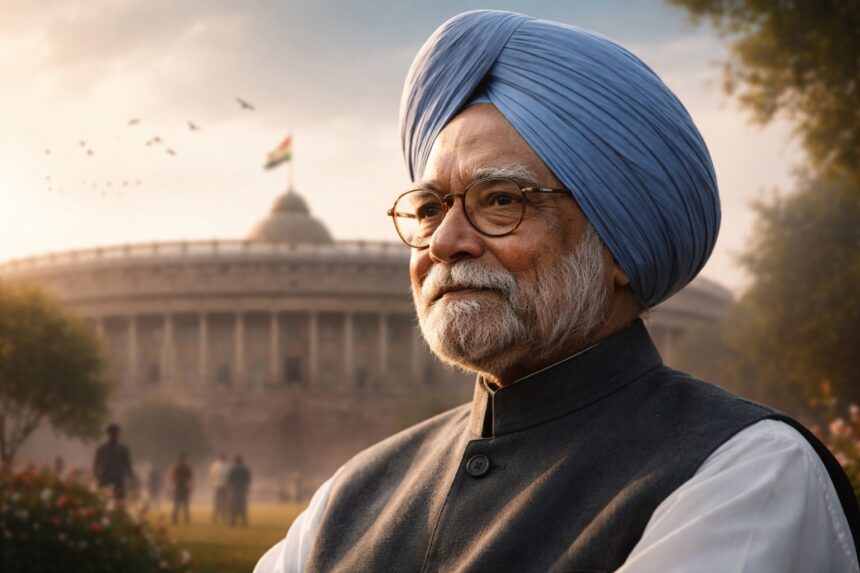
On the first death anniversary of Manmohan Singh, India pauses briefly to remember a leader who changed the country’s economic destiny without ever demanding applause. In an era dominated by optics, slogans, and personality-driven politics, Singh’s life offers a sharp contrast: leadership anchored in intellect, restraint, and institutional respect rather than spectacle.
Yet, the silence surrounding his remembrance is striking. There is no grand memorial in Delhi, no annual state-sponsored celebration, and little political urgency to keep his legacy alive. This absence itself says as much about contemporary politics as it does about the man.
A Leader Who Let Work Speak Louder Than Words
Manmohan Singh never cultivated a mass persona. He did not seek emotional connect through rhetoric, nor did he weaponise nationalism or identity. His authority stemmed from credibility earned through decades of academic rigour, bureaucratic excellence, and policy integrity.
In a political culture that increasingly rewards loudness, Singh’s calm demeanour was often misread as weakness. In reality, it reflected confidence rooted in knowledge. He governed not by dominating institutions, but by strengthening them.

Architect of India’s Economic Transformation
Singh’s most enduring contribution came long before he became Prime Minister.
The 1991 Economic Reforms
As Finance Minister, he dismantled the Licence Raj, liberalised trade, devalued the rupee, and opened India to global capital. These reforms:



- Pulled India back from a balance-of-payments crisis
- Shifted the economy from state control to market orientation
- Laid the foundation for sustained GDP growth, entrepreneurship, and global integration
Without 1991, there would be no IT boom, no startup ecosystem, no emergence of India as a credible global economic player.
As Prime Minister (2004–2014)
Under his leadership:
- India recorded one of its fastest growth phases, averaging 7–8%
- Fiscal responsibility frameworks were strengthened
- Landmark legislations like the Right to Information Act empowered citizens
- Social sector expansion (MGNREGA, education, health) ran parallel to economic growth
- India navigated the 2008 global financial crisis with relative stability
Singh proved that welfare and growth need not be opposing ideas.
Why Is There No Grand Remembrance?
The lack of visible commemoration no central memorial, no sustained political narrative raises uncomfortable questions.



1. He Didn’t Build a Personality Cult
Singh never branded himself. Modern politics thrives on icons; he believed in institutions. That makes him harder to “market” posthumously.
2. His Success Threatens Simplistic Narratives
Acknowledging Singh’s achievements forces recognition that economic progress can come from consensus, reform, and global engagement—not just muscular posturing.
3. Quiet Leaders Are Easy to Erase
History often favours the dramatic over the diligent. Singh’s legacy lives in balance sheets and institutions, not statues and slogans.
4. Political Credit Is Inconvenient
Much of today’s economic framework rests on reforms he initiated. Remembering him honestly complicates attempts to present India’s growth story as recent or singular.
The Irony of Silence
Perhaps the greatest irony is this: the more politics becomes performative, the more valuable Manmohan Singh’s example becomes.
He showed that:
- Power can be exercised without intimidation
- Leadership does not require constant visibility
- Policy competence outlasts political theatre
The absence of a memorial may diminish public memory, but it cannot erase impact. Every startup, every export milestone, every macroeconomic stability India enjoys traces back, in part, to decisions he took with courage and clarity.
A Legacy Beyond Monuments
Manmohan Singh may not have a towering memorial in Delhi, but his true monument is the modern Indian economy itself. Roads, offices, global boardrooms, and middle-class aspirations quietly bear his imprint.
History, unlike politics, has a longer memory. And in time, it is often the quiet reformer not the loud performer who endures. GBN