




Why peace is only the beginning for the world’s most important energy corridor
For the Gulf, the end of war does not automatically mean the return of stability. It means the beginning of a more complex economic test. The region has survived missiles, maritime disruption, investor anxiety and a severe interruption to the Strait of Hormuz but the bigger question now is whether it can restore the one asset on which its modern economic model rests: confidence.
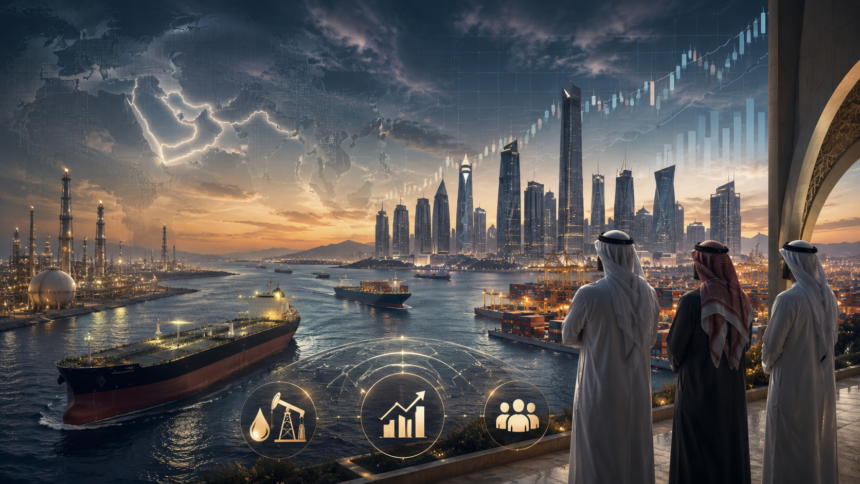
The Gulf’s post-war challenge can be understood in three parts: securing energy flows, repairing its reputation as a safe global business hub, and building a new regional security architecture that is not overly dependent on external powers.
The first challenge: making Hormuz reliable again
The Strait of Hormuz is not just a waterway. It is the pressure point of the global economy. The IMF estimates that around 25–30% of global oil and 20% of liquefied natural gas pass through the strait, making any disruption a direct threat to inflation, shipping costs and energy security across Asia and Europe.
Recent market behaviour shows why recovery will not be smooth. Reuters reported that crude prices returned close to pre-war levels, but the reopening of Hormuz triggered a chaotic rush of tankers and supply flows. Outbound oil cargoes have surged, but inbound vessels are still needed to restart production chains, especially for producers such as Kuwait, Bahrain, Qatar and Iraq, which have limited alternative export routes.


This is the Gulf’s first post-war problem: the market may forgive a short disruption, but it will price in repeated uncertainty. Insurance premiums, shipping routes, tanker availability and refinery planning will all carry a geopolitical surcharge unless Hormuz becomes predictably safe again.
The second challenge: repairing the Gulf’s investment brand
The Gulf has spent two decades selling itself as the world’s safest high-growth corridor: tax-friendly, infrastructure-rich, politically stable and globally connected. Dubai, Abu Dhabi, Doha and Riyadh are not merely cities; they are investment platforms.



War has dented that narrative.
The Stimson Center argues that while Gulf countries may have the financial capacity to absorb large repair costs, the harder task will be restoring their reputation for stability, a reputation central to their economic transformation plans. Oxford Economics also downgraded aggregate GCC real GDP growth for 2026 to -0.2%, citing weaker oil production, exports, tourism and domestic demand.
That matters because the Gulf’s diversification story depends on foreign capital behaving as if the region is insulated from conflict. Tourism, aviation, real estate, logistics, finance, data centres and sports investments all rely on continuity. Once boardrooms start adding “regional conflict exposure” to their risk models, capital does not disappear but it becomes more expensive.
The Gulf can rebuild towers quickly. Rebuilding investor psychology will take longer.


The third challenge: moving beyond borrowed security
For decades, Gulf security has relied on a familiar bargain: Western military protection in exchange for energy stability and strategic alignment. The war has exposed the limits of that arrangement.
Carnegie notes that the GCC had no decisive seat at the table in negotiations shaping its own economic and security environment. It also argues that Gulf states must deepen regional defence coordination, including air-defence manufacturing, anti-drone technology and integrated trade corridors.
This is perhaps the most important strategic lesson. The Gulf can no longer depend only on imported security guarantees. It needs shared air defence, stronger maritime coordination, alternative export routes, resilient ports, faster GCC rail connectivity and deeper diplomatic engagement with both Western and non-Western powers.
The future Gulf model cannot be “protected prosperity.” It has to be “resilient prosperity.”
Why India should watch closely
For India, this is not a distant West Asian story. It is an economic security issue. The GCC contributes about 35% of India’s oil imports and 70% of its gas imports, according to a parliamentary summary. The Indian mission in Riyadh also notes that nearly 10 million Indians live in GCC countries, with Gulf remittances accounting for almost 38% of India’s total remittance inflows in FY2024–25.
That means Gulf instability touches India through fuel prices, fertiliser costs, shipping insurance, remittances, jobs, aviation routes and inflation. For New Delhi, the post-war Gulf is not just a diplomatic concern; it is a macroeconomic variable.
The Gulf’s next decade will not be decided by how quickly it repairs physical damage. It will be decided by whether it can convince the world that its ports, pipelines, financial centres and skies are reliable even in a more militarised region.
The war has delivered a hard lesson: wealth can absorb shocks, but credibility must be rebuilt. The Gulf’s three post-war challenges Hormuz security, investor confidence and strategic autonomy will determine whether the region remains the world’s indispensable energy and capital hub, or becomes a premium-risk geography in a nervous global economy.