




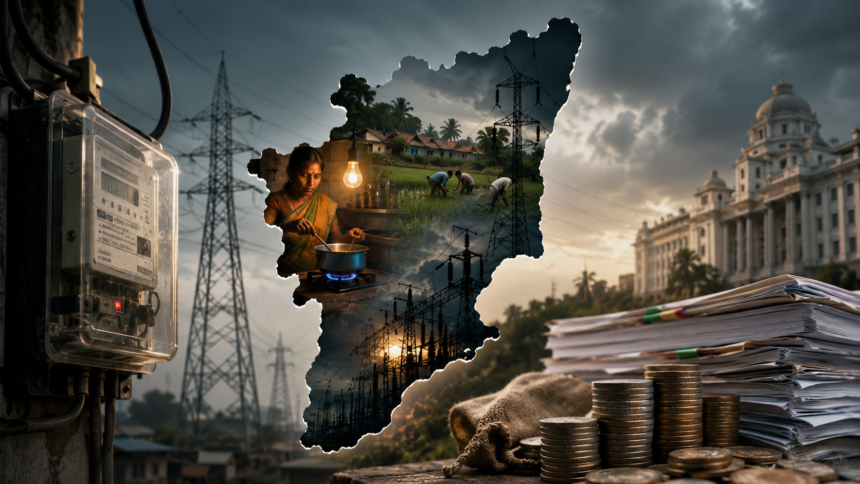
With outstanding debt and liabilities nearing ₹10 trillion in FY26, poorly targeted subsidies and mounting power-sector losses are placing increasing pressure on Tamil Nadu’s finances.
Tamil Nadu’s fiscal challenge is often framed as a debate between welfare and economic discipline. That is the wrong diagnosis.
The state’s welfare model has contributed significantly to its progress in education, healthcare, nutrition and industrial development. The real problem is not welfare expenditure itself, but the growing cost of subsidies that are poorly targeted, insufficiently monitored and increasingly financed through debt.
Tamil Nadu’s outstanding debt and liabilities reached nearly ₹10 trillion in FY26, almost twice the level recorded in FY21. Its debt-to-Gross State Domestic Product ratio rose to around 28.3%, while contingent liabilities increased to approximately ₹1.8 trillion.
A large part of this fiscal risk originates in the power sector.
Discom Losses Are Moving Onto the State’s Balance Sheet
Tamil Nadu’s electricity utilities have accumulated substantial debt because the revenue collected from consumers remains below the cost of supplying power.
When a distribution company cannot cover its expenses, the state eventually steps in through grants, guarantees, equity support or direct funding of losses. What appears to be the debt of a public-sector company ultimately becomes a burden on taxpayers.


Power-sector entities reportedly accounted for nearly 80% of the state’s outstanding guarantees in FY26. The debt of the Tamil Nadu Electricity Board group stood at around ₹2.47 lakh crore, while accumulated losses were estimated at nearly ₹1.82 lakh crore.
This is not simply an accounting problem. It is the result of a business model in which tariffs, collections and subsidy compensation have failed to keep pace with the actual cost of electricity.
Restructuring the electricity board into separate generation and distribution companies may improve administrative focus. But separating entities will not eliminate losses unless the underlying financial model is corrected.
Universal Subsidies Are Weakening Targeted Welfare
Tamil Nadu provides the first 100 units of domestic electricity free on a bimonthly basis, regardless of household income.



The scheme offers relief to low-income families, but it also benefits households that can afford to pay. Reports indicate that a large majority of consumers in the wealthiest expenditure groups also receive free electricity.
This weakens the economic justification for the subsidy.
Social support should protect vulnerable households. It should not automatically subsidise affluent consumers, large homes and high-income families. Every rupee spent on an unnecessary subsidy is a rupee unavailable for schools, hospitals, public transport, climate resilience or industrial infrastructure.
Tamil Nadu’s power subsidy bill was estimated at more than ₹32,000 crore in FY24. The state’s discoms also accounted for a significant share of the losses recorded by state-owned electricity distributors across India.
The issue, therefore, is not whether electricity should be subsidised. It is whether the subsidy reaches the people who genuinely need it.
Interest Costs Are Crowding Out Investment
Tamil Nadu’s fiscal pressure is increasingly visible in the composition of government spending.
Interest payments were projected at roughly ₹67,000 crore in FY26, exceeding capital expenditure of about ₹51,000 crore. This means the state is spending more on servicing past borrowing than on creating new productive assets.
That is the real warning sign.
Debt can support growth when it finances roads, ports, power infrastructure and urban development. But when borrowing is repeatedly used to fund subsidies, operational losses and interest obligations, the state’s capacity to invest in future growth begins to weaken.
Reform Without Abandoning Welfare
Tamil Nadu does not need indiscriminate austerity. It needs better targeting and greater transparency.
Basic electricity support should continue for poor and vulnerable households. However, benefits can be gradually withdrawn from affluent consumers using consumption levels, property ownership and income-tax information.
Agricultural electricity should be properly metered even when it remains subsidised. This would allow the government to calculate the actual cost of support and distinguish genuine welfare expenditure from operational inefficiency.
Financial assistance to electricity companies must also be linked to measurable improvements in billing, collection, distribution losses and power procurement.
Tamil Nadu’s welfare system remains an economic asset. But welfare becomes sustainable only when it is targeted, transparent and fiscally responsible.
Unless the state reforms its subsidy architecture and power utilities, electricity concessions meant to ease household expenses may continue to deepen a much larger fiscal burden.