






Why RBI Crypto Policy Matters for India’s Financial Stability
RBI Crypto Policy: VDAs Can Be Assets, Not Currency
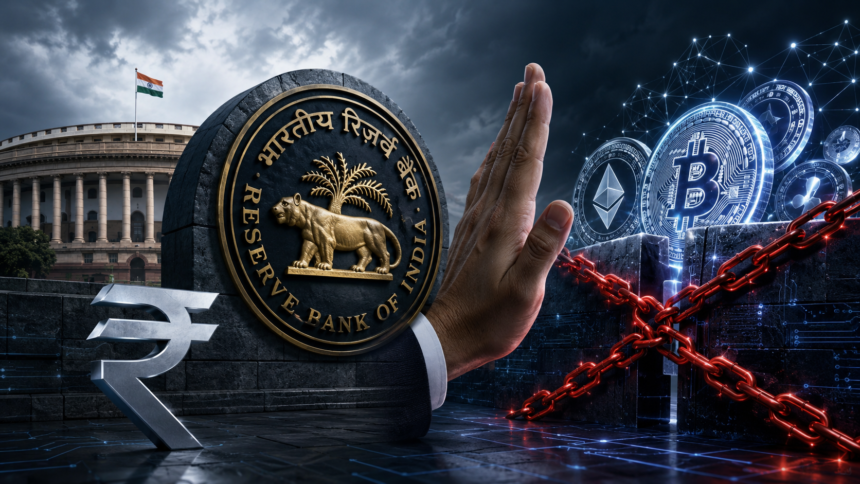
The Reserve Bank of India has once again drawn a clear red line on crypto. In its submission to a Parliamentary panel on Virtual Digital Assets, the central bank made its position unmistakable: cryptocurrencies and private digital assets should not be treated as currency in India.
The phrase that captured the moment was striking — “not having a policy is also a policy.” It was a blunt response to lawmakers who questioned whether India could afford an ostrich-like approach while other markets such as Hong Kong, the UAE and Indonesia were moving toward regulatory frameworks.
At one level, the RBI’s caution is understandable. Currency is not merely a medium of exchange; it is a sovereign instrument. It carries the authority of the state, the discipline of monetary policy, and the backing of public trust. A privately issued crypto token cannot be allowed to compete with the rupee in payments, settlements or savings without creating risks that go far beyond investor losses.
The RBI’s worry is not just about speculation. It has flagged the possible use of VDAs in illicit financing, including drug trafficking and terror funding. It has also warned against giving banks and regulated financial institutions exposure to crypto assets and privately issued stablecoins, arguing that such exposure could legitimise products with limited economic value while deepening systemic risk.

India’s current framework is already a contradiction. Crypto is taxed, monitored and partially brought under anti-money laundering obligations, but it is not recognised as legal tender or a regulated financial product. Under Section 115BBH of the Income-tax Act, income from transfer of VDAs is taxed at 30%, with no deduction other than cost of acquisition and no set-off of losses. Section 194S further requires 1% TDS on VDA transfers beyond specified thresholds.
This creates a policy grey zone. The state taxes crypto profits, tracks transactions, and requires compliance from service providers — but stops short of granting legitimacy. For the RBI, that ambiguity is deliberate. For investors and entrepreneurs, it is uncertainty. For policymakers, it is a strategic dilemma.



The central bank is right on one fundamental point: crypto should not become currency. India cannot permit a parallel monetary system that weakens the rupee, complicates capital controls, or reduces the effectiveness of monetary policy. In an emerging economy where financial stability matters as much as innovation, the cost of a reckless crypto experiment could be high.
But the larger question is whether “no policy” can remain India’s long-term policy. In reality, the market does not disappear because regulation is delayed. It merely moves offshore, underground, or into informal channels. That is precisely why the Finance Ministry and FIU-IND have already had to bring VDA service providers under anti-money laundering and counter-terror financing obligations. FIU-IND has stated that VDA service providers operating in India, whether offshore or onshore, must register as reporting entities and comply with PMLA obligations.
Globally too, the regulatory direction is not simply “ban or legalise.” The Financial Stability Board’s framework is built around the principle of “same activity, same risk, same regulation,” while seeking consistent oversight of crypto assets and stablecoins. That does not mean India must copy Western or Gulf models. It means India needs its own containment framework — one that ring-fences banks, prohibits crypto use in payments, strengthens KYC and reporting, protects consumers from misleading claims, and clearly distinguishes blockchain innovation from speculative tokens.
The RBI’s hard line should therefore be read not as hostility to technology, but as a warning against monetary adventurism. Blockchain, tokenisation and digital public infrastructure may all have productive use cases. But private crypto tokens seeking currency-like status are a different matter altogether.



India’s policy choice should be clear: crypto can be treated as a high-risk digital asset, but never as currency. Innovation can be permitted where it serves economic value; speculation must not be allowed to masquerade as financial progress.
The RBI has protected the sanctity of the rupee. Now the government must remove the fog around VDAs. A policy of deliberate distance may work for a while. But in a fast-moving financial world, silence itself becomes a signal — and India must ensure that signal is not mistaken for indecision.