






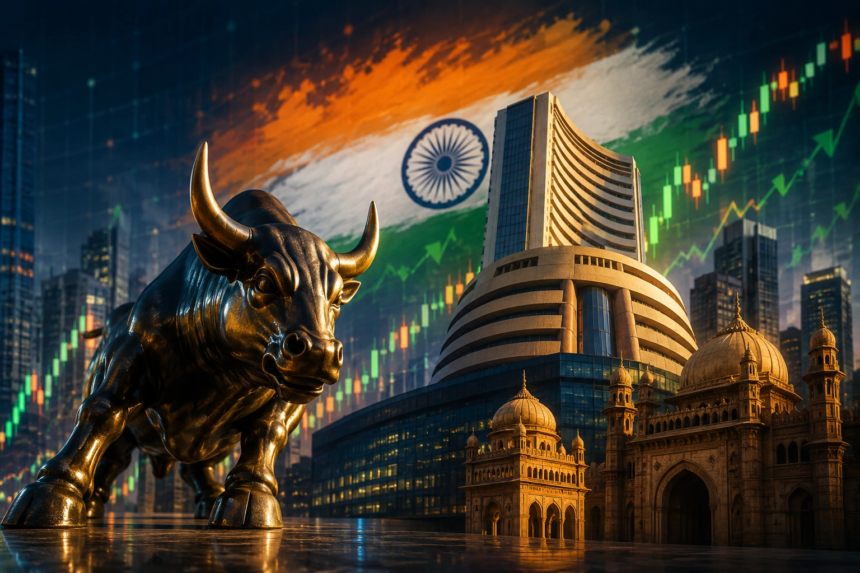
India’s stock market has long been viewed as a symbol of the country’s economic rise. Yet, in a notable development, India recently slipped from the world’s fifth-largest stock market to the seventh-largest, with its total market capitalization falling to around $4.18 trillion. While India remains one of the fastest-growing major economies, the decline has raised important questions about investor confidence and the country’s dependence on foreign capital.
A significant factor behind this shift has been the sustained selling by Foreign Portfolio Investors (FPIs), who have withdrawn billions of dollars from Indian markets in search of better opportunities elsewhere. As foreign money flowed out, market valuations came under pressure, reducing India’s overall market value and allowing other countries to move ahead in global rankings.
The Recent Wave of Foreign Investor Outflows
Foreign Portfolio Investors (FPIs) play a significant role in India’s stock markets. Unlike Foreign Direct Investment (FDI), which involves long-term commitments such as factories, infrastructure projects, and business operations, FPIs primarily invest in stocks and bonds. Because these investments are highly liquid, foreign investors can move capital in and out of markets rapidly in response to changing economic conditions, risk perceptions, and global opportunities.
The scale of recent FPI withdrawals illustrates this dynamic. During 2025, foreign investors pulled out nearly ₹1.66 lakh crore from Indian equities. The trend has continued into 2026, with FPIs withdrawing approximately ₹2.25 lakh crore from Indian markets so far. In May 2026 alone, foreign investors sold Indian equities worth ₹32,963 crore, reflecting a significant shift in investor sentiment.
Several factors have contributed to this sustained outflow. Slower corporate earnings growth, concerns over the depreciation of the Indian rupee, elevated market valuations, and persistent global uncertainties have prompted investors to reassess their exposure to Indian equities. At the same time, higher returns available in developed markets, particularly the United States, have encouraged capital to move away from emerging economies such as India.

The consequences have been visible. India’s stock market capitalization has declined to around $4.18 trillion, causing the country to fall from the fifth-largest stock market in the world to the seventh position. Such a decline demonstrates how strongly market valuations can be affected by shifts in foreign investor behavior, even when the broader economy remains relatively stable.
More importantly, these outflows expose a deeper characteristic of the Indian stock market: its vulnerability to external financial forces. A substantial portion of market performance can be influenced by decisions made by global investors whose priorities may have little to do with India’s domestic economic conditions. Changes in interest rates abroad, geopolitical tensions, currency movements, or shifts in global risk appetite can trigger large capital movements that affect Indian stock prices and market sentiment.
While foreign capital brings liquidity and investment opportunities, the recent withdrawals highlight the uncertainty inherent in a market that is closely tied to global financial flows. When hundreds of thousands of crores can leave within a short period, affecting valuations, investor confidence, and even India’s position in global market rankings, it becomes clear that the Indian stock market remains highly sensitive to external shocks and investor sentiment beyond its control.
Why Are Foreign Investors Pulling Money Out?



One of the biggest reasons has been the rise in interest rates in the United States.
When the US Federal Reserve increases interest rates, investors can earn attractive returns from relatively safe assets such as US Treasury bonds. As a result, some investors reduce their exposure to emerging markets like India and shift funds back to the United States.
Another factor is global uncertainty. Wars, trade disputes, inflation concerns, and fears of economic slowdown often push investors toward safer assets. During such periods, emerging markets are usually among the first to experience capital outflows.
Valuation concerns also play a role. India’s stock market has often traded at a premium compared to many other emerging markets. While this reflects confidence in India’s long-term prospects, it also encourages investors to book profits when valuations appear stretched.
In short, foreign investors do not necessarily leave because India’s economy is weak. They often leave because opportunities elsewhere appear more attractive.
Where Does the Money Go?
When foreign investors withdraw capital from India, the money rarely sits idle. Global investment funds constantly seek the best combination of returns, stability, and risk management. As a result, capital often flows toward markets that appear more attractive at a given point in time.
The United States has been one of the primary destinations for capital leaving India. Higher interest rates have increased the attractiveness of US Treasury bonds, allowing investors to earn relatively strong returns with significantly lower risk. At the same time, the continued dominance of major American technology companies has attracted substantial global investment, particularly in sectors linked to artificial intelligence, semiconductors, and digital innovation.
Beyond the United States, markets such as Japan and parts of Europe have also benefited from shifting investor preferences. Japan’s corporate reforms, improving profitability, and relatively attractive valuations have drawn increased foreign interest. In Europe, certain sectors have offered investors opportunities to diversify their portfolios while reducing exposure to emerging-market volatility.
Capital has also moved into other emerging markets when investors perceived them to be undervalued compared to India. As Indian equities traded at premium valuations, some global funds redirected investments toward markets where they believed future returns could be higher relative to the risks involved.
This highlights a fundamental reality of modern finance: capital has no permanent home. Global investors do not allocate money based on national loyalty or long-term commitment to a country’s development. They continuously compare opportunities across regions, sectors, and asset classes, moving funds wherever they expect the best risk-adjusted returns.
For India, this serves as an important reminder that foreign capital is inherently opportunistic. While it can accelerate growth during favorable periods, it can also leave quickly when global conditions change. The challenge, therefore, is not to prevent capital from moving, but to ensure that India’s financial markets are resilient enough to withstand these shifts without excessive disruption.
Which Sectors Feel the Impact the Most?
Financial services often experience significant pressure because banks and financial institutions attract substantial foreign investment. Large private-sector banks are frequently among the most heavily owned stocks by foreign investors.
The information technology sector is another area of vulnerability. Since IT companies depend heavily on global demand, foreign investors closely monitor economic conditions in major markets such as the United States and Europe.
Consumer-focused companies can also be affected, particularly when their valuations are considered expensive relative to future growth expectations.
The start-up ecosystem faces its own challenges. Venture capital and private equity investments often slow during periods of global uncertainty, making it harder for young companies to raise funds.
What Does This Say About the Vulnerability of India’s Stock Market?
Foreign investor outflows do not automatically indicate economic weakness. However, they do reveal certain structural vulnerabilities within the market.
One vulnerability is the concentration of foreign ownership in large-cap stocks. When foreign funds sell aggressively, the impact is often felt disproportionately in major index constituents, causing broader market declines even when the underlying businesses remain fundamentally strong.
Another vulnerability is the speed at which sentiment can change. Modern financial markets are deeply interconnected. A policy decision in Washington, a banking crisis in Europe, or geopolitical tensions in another region can trigger selling pressure in Indian markets within hours.
There is also the issue of perception. Sharp foreign outflows can create the impression that investors are losing confidence in India, even when the actual reasons are global rather than domestic. This can amplify volatility as local investors react to market movements rather than economic fundamentals.
Perhaps the biggest concern is that stock market performance can become increasingly influenced by external factors that India cannot directly control. Interest-rate decisions by foreign central banks, global risk appetite, and international capital flows can sometimes have a greater short-term impact on markets than domestic economic developments.
Is Reliance on Foreign Investors a Good Idea?
The answer is both yes and no.
Foreign investment brings significant benefits. It increases market liquidity, provides access to global capital, improves corporate governance standards, and helps businesses expand more rapidly. India’s economic rise would have been far more difficult without foreign investment.
However, there is a difference between benefiting from foreign capital and becoming excessively exposed to its movements.
Foreign investors invest for returns, not for national development. Their primary responsibility is to their shareholders and clients. If better opportunities emerge elsewhere, they will move their money accordingly.
This means that foreign capital can sometimes amplify market volatility. A sudden withdrawal of funds may not reflect weakness in India’s economy, yet it can still create significant disruptions in financial markets.
A healthy market should be able to absorb such movements without experiencing disproportionate instability.
What Can India Learn from Other Countries?
Several countries have faced similar challenges and developed mechanisms to reduce the impact of volatile capital flows.
Japan’s financial markets have historically benefited from a large and stable domestic investor base, which helped cushion external shocks.
China has often used regulatory controls and gradual market liberalization to manage the pace and impact of foreign capital movements.
South Korea experienced significant volatility during the Asian Financial Crisis and subsequently strengthened financial regulation, foreign-exchange reserves, and market oversight to improve resilience.
These examples show that while foreign capital can accelerate growth, market stability often depends on the ability to withstand sudden shifts in investor sentiment.
How Can India Reduce Market Vulnerability?
The objective should not be to prevent foreign investors from entering or leaving the market. Capital mobility is a normal feature of a globalized financial system.
Instead, the focus should be on reducing the market’s sensitivity to abrupt capital movements.
One approach is to deepen market participation across a broader range of investors and institutions so that selling by one group does not disproportionately affect prices.
Regulators can also continue strengthening market surveillance and risk-management systems to ensure that periods of heavy selling do not trigger unnecessary panic or systemic stress.
Maintaining strong macroeconomic fundamentals is equally important. Stable inflation, prudent fiscal management, healthy foreign-exchange reserves, and a credible monetary policy framework can help reassure investors during periods of uncertainty.
Transparency and timely communication from policymakers can also reduce the risk of overreaction when foreign outflows occur.
Finally, investors themselves need to recognize that foreign selling is not always a verdict on India’s economic prospects. Understanding the global factors behind capital flows can help prevent short-term market movements from being mistaken for long-term economic trends.
The Road Ahead
Foreign investment will remain important for India’s development. In an interconnected world, no major economy can or should isolate itself from global capital flows.
The goal should not be to reduce foreign investment but to reduce vulnerability to sudden capital movements.
A resilient stock market is not one that never experiences foreign investor withdrawals. Rather, it is one that can absorb those withdrawals without excessive volatility, loss of confidence, or disruption to the broader economy.
India’s challenge is therefore not attracting more foreign capital. It is ensuring that market stability does not depend excessively on the decisions of investors sitting thousands of miles away.
As India’s economy continues to grow, the real test will be whether its financial markets can remain stable and confident even when global money decides to move elsewhere.