




As artificial intelligence enters formal proof systems, mathematics may be moving toward a future where complex ideas are not merely argued, but machine-verified.
Mathematics has always occupied a special position in human knowledge. Unlike politics, markets or social sciences, mathematics is built on proof. A theorem is not accepted because it is popular, persuasive or profitable. It is accepted because it can be logically demonstrated.
Yet, behind this ideal of certainty lies a very human process. Mathematical proofs are written in natural language, reviewed by experts, debated in journals and gradually accepted by academic communities. The process works, but it is slow, specialised and increasingly difficult to scale.
Modern mathematics has become so advanced that some proofs run into hundreds of pages and require expertise across multiple subfields. In such cases, even highly respected mathematicians may need years to verify whether a proof is correct. The bottleneck is no longer just discovery. It is verification.
Artificial intelligence could change that.

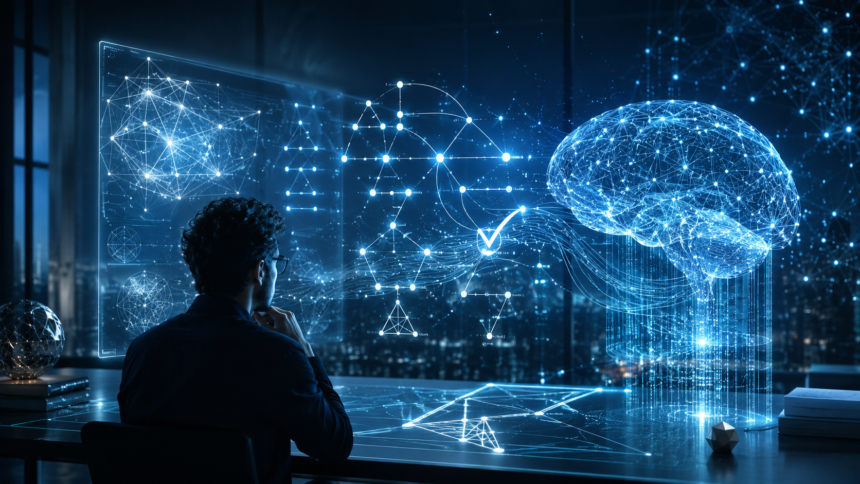
The next major contribution of AI to mathematics may not be simply solving difficult problems. It may be creating a common language through which mathematical proofs can be written, checked and trusted by both humans and machines.
This shift is already taking shape through formal proof assistants such as Lean, Coq and Isabelle. These systems allow mathematical statements and proofs to be written in a precise, computer-readable language. Unlike ordinary mathematical writing, where a proof may depend on interpretation, style or assumed background knowledge, formal proofs are checked line by line by software.



If a proof passes through such a system, every logical step has been verified. There is no room for elegant but incomplete reasoning. There is no tolerance for hidden assumptions. The proof either works or it does not.
For mathematicians, this offers a new level of confidence. For artificial intelligence, it offers something equally important: a reliable environment where its reasoning can be tested.
This is crucial because current AI models are powerful but not always dependable. They can generate convincing explanations, identify patterns and suggest solutions. But they can also make mistakes with confidence. In ordinary writing, that may be inconvenient. In mathematics, it is fatal. A single flawed step can invalidate an entire proof.
Formal proof systems therefore act as a discipline mechanism for AI. They force AI-generated reasoning to meet the highest standard of logic. The model cannot simply sound correct. It must be correct.



This is where the idea of a “common language” becomes significant. Mathematics already uses symbols, equations and specialised notation. But those are not always enough. Different branches of mathematics may use different conventions. A proof that is obvious to one expert may be opaque to another. Much of mathematical knowledge still lives in textbooks, journal papers, lecture notes and the minds of specialists.
Formal proof languages could transform this scattered knowledge into structured, reusable infrastructure.
Once a theorem is formally encoded, it becomes searchable, verifiable and reusable by others. Future mathematicians and AI systems can build on it without having to re-check every detail from the beginning. Over time, this could create a global library of verified mathematical knowledge.
The business analogy is clear. Accounting standards allow investors to compare companies. Software protocols allow systems to communicate. Legal frameworks allow contracts to be enforced. In the same way, formal proof languages could become the protocol layer for mathematical truth.
The implications go far beyond academia.
Formal verification already has major relevance in software engineering, semiconductor design, cybersecurity, aerospace, financial systems and artificial intelligence safety. In industries where failure is expensive or dangerous, proving that a system behaves correctly is not a luxury. It is a strategic necessity.
As businesses become more dependent on AI, automation and complex algorithms, the ability to verify outcomes will become a competitive advantage. Banks will need more reliable risk models. Technology companies will need safer software systems. Governments will need trustworthy digital infrastructure. AI developers will need ways to prove that critical systems follow intended rules.
Mathematics, in this sense, is not an isolated intellectual pursuit. It is the foundation of the modern trust economy.
AI-assisted proof verification could therefore become part of a much larger enterprise story: the move from probabilistic confidence to formal assurance. Today, many AI systems operate on statistical probability. They predict likely answers based on patterns in data. But for high-stakes sectors, probability may not be enough. Businesses will increasingly ask: Can this be verified? Can this be audited? Can this be trusted?
Formal mathematics may provide part of that answer.
However, the road ahead is not simple.
Formalising mathematics is difficult and time-consuming. A proof that a human expert can understand in a few paragraphs may require many detailed steps in a proof assistant. Existing formal libraries are growing, but they still do not cover the full breadth of mathematics. AI models are improving, but they are not yet reliable enough to independently handle the deepest research problems.
There is also a cultural challenge. Mathematics is not only about correctness. It is about understanding. A computer-verified proof may confirm that a theorem is true, but mathematicians still want to know why it is true. They want insight, elegance and explanation. A proof that is mechanically valid but intellectually unreadable may solve one problem while creating another.
This is why the most likely future is not AI replacing mathematicians. It is AI working with mathematicians.
Human researchers will continue to frame the big questions, develop intuition, identify meaningful patterns and decide which problems matter. AI systems can assist by converting informal ideas into formal proofs, checking gaps, suggesting intermediate steps and searching vast libraries of known results.
The mathematician becomes less like a manual proof-checker and more like an architect of reasoning. The AI becomes a tireless verifier and collaborator.
For the business world, this is an important lesson. The most valuable use of AI is not always replacement. Often, it is standardisation, acceleration and trust-building. In mathematics, AI may standardise proof verification. In business, similar models may standardise compliance, auditing, coding, research and risk management.
The larger trend is clear: AI is moving from content generation to knowledge verification.
The first wave of generative AI impressed the world by writing text, creating images and generating code. The next wave may be judged by something more serious: whether AI can help institutions trust what they produce.
Mathematics is the ideal testing ground because the standards are unforgiving. There are no partial truths in proof. Either the argument holds, or it fails.
If AI can help create a shared, formal language for mathematics, it could reshape one of humanity’s oldest knowledge systems. It could make proofs easier to verify, easier to share and easier to build upon. It could reduce the time between discovery and acceptance. It could open advanced mathematics to broader collaboration between humans and machines.
The real breakthrough, then, may not be an AI system that produces a single spectacular theorem. It may be the creation of a new infrastructure for certainty.
For centuries, mathematics has depended on trust between experts. In the AI era, that trust may increasingly be supported by formal verification. The future of mathematical proof may be written in a language that both humans and machines can understand.
And that may be one of AI’s most important contributions to knowledge itself.