




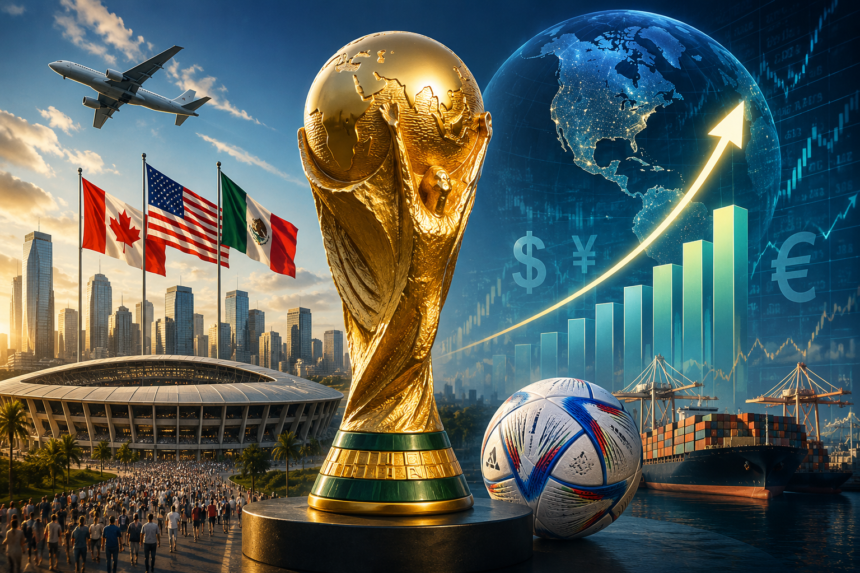
When you hear “FIFA World Cup,” what comes to mind? Perhaps it’s the iconic World Cup anthems that still send chills down our spine, legendary football heroes, unforgettable goals, dramatic victories, and heartbreaking defeats. For fans, the World Cup is a celebration of passion and national pride. But beyond the stadiums and television screens lies another story—one measured not in goals, but in billions of dollars. Every World Cup brings with it a massive economic engine that drives tourism, media revenues, sponsorship deals, infrastructure investment, and global business opportunities.
The FIFA World Cup 2026, hosted jointly by the United States, Canada, and Mexico, is set to become the largest World Cup in history. With 48 teams, 104 matches, and millions of expected visitors, the tournament is not just a sporting spectacle—it is a global business event worth billions of dollars.
In many ways, the World Cup has evolved into one of the world’s most powerful economic platforms, generating value far beyond football itself.
More Than a Tournament

The World Cup is the most-watched sporting event on the planet. Billions of viewers from nearly every country follow the tournament, creating enormous opportunities for broadcasters, sponsors, advertisers, and host nations.
For the host countries, the tournament is much more than a celebration of sport. It attracts tourists, stimulates local businesses, creates employment, and places host cities at the center of global attention.



The 2026 edition will be particularly significant because it will be spread across three countries and sixteen cities, creating an economic footprint unlike anything seen before in football history.
The Tourism Gold Rush
One of the biggest beneficiaries of the World Cup is the tourism industry.
Millions of fans are expected to travel across North America during the tournament, spending money on hotels, restaurants, transportation, entertainment, shopping, and local attractions.


Unlike traditional tourists who often stay in one location, football supporters frequently travel between cities to follow their teams. This spreads economic benefits across multiple regions and industries.
For local businesses, the World Cup represents a rare opportunity to attract international customers and generate substantial revenue within a short period.
The Broadcasting Empire
While players compete on the field, broadcasters compete for audience attention.
Television networks and streaming platforms spend billions of dollars securing broadcasting rights because live sports remain one of the few forms of content capable of attracting massive real-time audiences.
The World Cup’s global reach makes it especially valuable. Advertisers are willing to pay premium rates to access billions of viewers, transforming football matches into some of the most lucrative media events in the world.
This is why broadcasting rights have become FIFA’s single largest source of revenue.
Where Does FIFA’s Money Come From?
The scale of FIFA’s business becomes clear when examining its revenue sources. During its previous commercial cycle, FIFA generated approximately $7.57 billion in revenue.
| Revenue Source | Revenue | Share |
| Television & Broadcasting Rights | $3.43 billion | 45.3% |
| Sponsorship & Marketing Rights | $1.80 billion | 23.7% |
| Ticket Sales & Hospitality | $949 million | 12.5% |
| Licensing & Merchandise | $769 million | 10.2% |
| Other Revenue | $629 million | 8.3% |
| Total Revenue | $7.57 billion | 100% |
The numbers reveal an important reality: FIFA is not merely a sporting organization—it is also a global media and entertainment business.
Nearly half of its revenue comes from broadcasting rights alone. Sponsorships form the second-largest source, highlighting the immense commercial value associated with the World Cup brand.
Sponsorship: The World’s Biggest Marketing Stage
For global corporations, the FIFA World Cup is one of the most powerful marketing platforms ever created.
Companies spend billions to associate their brands with football’s biggest event. Their logos appear in stadiums, television broadcasts, digital campaigns, and social media content viewed by audiences across the globe.
Why are companies willing to spend so much?
Because the World Cup offers something few events can match: global visibility combined with emotional engagement. Fans are deeply invested in their national teams, making the tournament a unique opportunity for brands to connect with consumers.
Why FIFA World Cup 2026 Could Break Revenue Records
The 2026 tournament is expected to become the most commercially successful World Cup in history.
Several factors support this expectation:
- Expansion from 32 teams to 48 teams
- Increase from 64 matches to 104 matches
- More ticket sales
- Greater sponsorship opportunities
- Increased broadcasting inventory
- Larger global audience reach
As a result, FIFA projects that its revenue cycle leading up to the 2026 World Cup could exceed $11 billion, significantly higher than the approximately $7.6 billion generated during the previous cycle.
The benefits extend far beyond FIFA itself.
Economic studies estimate that the tournament could generate more than $40 billion in economic output across North America, driven by tourism spending, infrastructure investment, business activity, and job creation.
Infrastructure and Long-Term Investment
Major sporting events often accelerate infrastructure development, and the World Cup is no exception.
Host cities have invested heavily in stadium upgrades, transportation systems, airports, hospitality facilities, and digital infrastructure.
While these investments are intended to support the tournament, their impact can continue long after the final whistle. Improved transportation networks and upgraded public facilities can enhance economic productivity and tourism for years to come.
The challenge for host cities is ensuring that these investments deliver long-term value rather than becoming expensive short-term projects.
Soft Power: The Hidden Economic Asset
Perhaps the most overlooked benefit of hosting the World Cup is the growth of soft power.
The tournament allows countries to showcase their culture, infrastructure, technological capabilities, and business environment to a global audience.
A successful World Cup can strengthen a nation’s international reputation, attract future investment, boost tourism, and enhance diplomatic influence.
In an increasingly competitive global economy, reputation itself has become a valuable economic asset.
More Than Just Football
What makes the World Cup remarkable is that FIFA does not manufacture a traditional product. Instead, it sells something far more valuable: attention.
Every goal, every upset, and every dramatic moment generates economic value for broadcasters, sponsors, airlines, hotels, restaurants, and host cities.
In an age where audience attention is increasingly fragmented, live sports remain one of the few experiences capable of bringing billions of people together at the same moment.
That is why the FIFA World Cup is no longer just a football tournament.
It is one of the most powerful economic engines in the modern world.
The FIFA World Cup 2026 will ultimately crown a champion on the field. But away from the stadiums, another competition will be taking place—a competition for tourism, investment, business opportunities, and global influence.
And in that contest, the stakes may be even higher than the trophy itself.