




War, Oil & Monsoon Risks: Is India Heading Toward an Austere Summer?

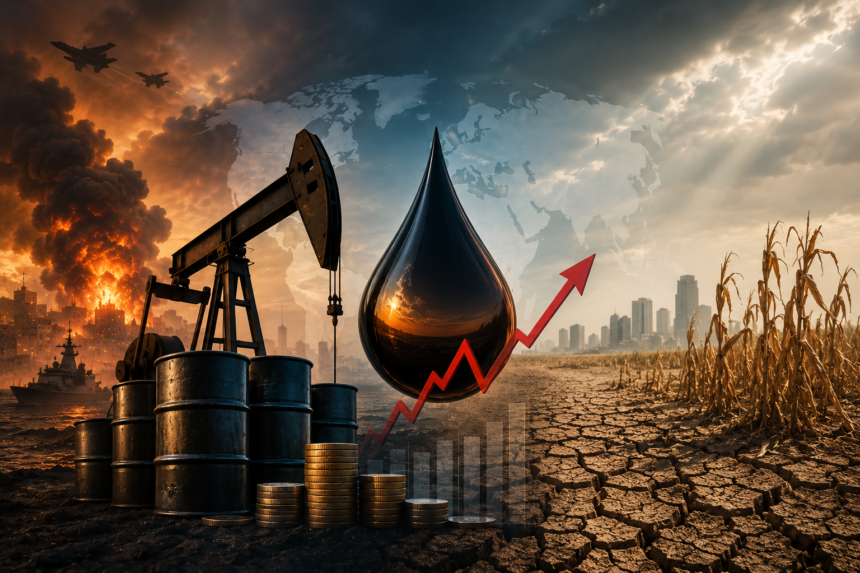
The global economy has entered another phase of uncertainty — and for India, the timing could not be worse. A widening conflict in West Asia, combined with forecasts of a weaker monsoon, is beginning to pressure inflation, growth, and the country’s external balance.
For a country that imports nearly 85% of its crude oil needs, instability in West Asia is not a distant geopolitical issue. It directly affects fuel prices, transport costs, inflation, and household spending. According to government estimates, every $10 increase in crude oil prices can widen India’s current account deficit by nearly 0.4% of GDP and raise retail inflation significantly.
The question is no longer whether India will feel the impact. The real question is whether the economy can absorb another global shock without slowing significantly.
The Return of the Oil Shock
Every major conflict in West Asia tends to shake global oil markets. Even the fear of supply disruptions pushes crude prices upward.
India imports more than 5 million barrels of crude oil per day, making it one of the world’s largest energy importers. Nearly 60% of these imports come from West Asian nations, including Iraq, Saudi Arabia, and the UAE.
Higher crude prices create a ripple effect across the economy:
Increased transport and logistics costs
Higher manufacturing expenses
Rising fertilizer and agriculture input costs
Inflation in essential goods
India’s retail inflation had already remained above the RBI’s comfort level for several months in recent years. If Brent crude sustains above the $100-per-barrel mark, inflationary pressure could intensify further while the rupee faces additional stress.
The Monsoon Factor
Alongside oil prices, the monsoon remains a major concern.
Despite rapid urbanisation, agriculture still supports nearly 42% of India’s workforce, while contributing around 15–16% of GDP. A weaker monsoon affects not just farm output, but also rural demand and food prices.
Food inflation remains one of India’s biggest economic sensitivities. Items like vegetables, pulses, cereals, and edible oils heavily influence household spending patterns. In previous years, poor rainfall has led to sharp spikes in tomato, onion, and cereal prices across urban and rural markets.
This creates a dual inflation risk:
Imported inflation from oil and domestic inflation from food supply pressures.
That combination becomes particularly difficult for policymakers.
RBI’s Balancing Act
The Reserve Bank of India now faces a difficult balancing act.
India’s repo rate currently remains elevated compared to pre-pandemic levels as the central bank continues its inflation-control approach. If crude and food prices rise together, the RBI may be forced to maintain tighter monetary conditions for longer.
The RBI’s focus will likely remain on:
Controlling inflation
Protecting the rupee
Supporting economic stability
Managing all three simultaneously during a global crisis will not be easy.
Can India Ride Out the Storm?
India enters this period stronger than in earlier oil crises.
The country’s foreign exchange reserves remain above $650 billion, providing a significant buffer against currency volatility and external payment pressure. India has also diversified crude sourcing in recent years, including increased purchases from Russia after the Ukraine conflict.
In addition, GST collections continue to remain strong, frequently crossing ₹2 lakh crore in recent months, indicating resilience in economic activity despite global uncertainty.
But resilience does not mean immunity.
Consumers and businesses may still face an “austere summer” marked by:
Sticky inflation
Higher fuel and travel costs
Pressure on household budgets
Slower discretionary spending
A Crisis That Could Accelerate Change
Economic shocks often force structural transformation.
India has already accelerated investments in renewable energy, electric mobility, and domestic manufacturing. The country aims to achieve 500 GW of non-fossil fuel energy capacity by 2030, reducing long-term dependence on imported fossil fuels.
The broader lesson is becoming increasingly clear: long-term economic resilience will depend heavily on energy security and climate preparedness.
Final Word
India is unlikely to collapse under the pressure of a West Asia conflict and weak monsoon. The economy today is larger, more diversified, and institutionally stronger than in previous decades.
But the coming months may test both policymakers and consumers.
If inflation remains under control and growth momentum holds, India could emerge from this phase relatively stable. But if oil prices and food inflation rise together for an extended period, the pressure on households and businesses will become difficult to ignore.
An austere summer may indeed lie ahead — but it could also become another defining stress test for India’s economic resilience.
Leave a Comment