






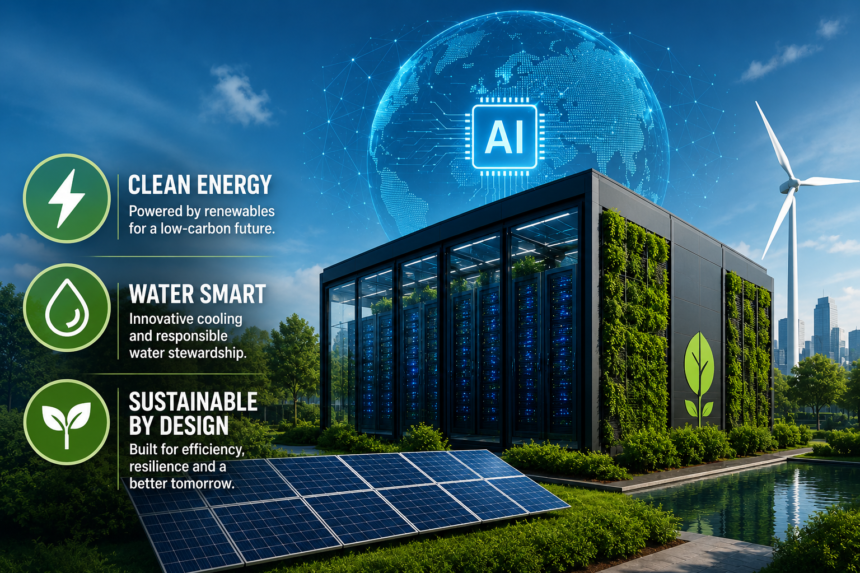
Artificial intelligence may be digital in experience, but its foundations are deeply physical. Behind every chatbot response, image generator, medical model, trading algorithm and enterprise automation system sits a vast industrial machine: the data centre. It consumes electricity, requires water, depends on land, demands cooling, and increasingly competes with cities, factories and households for critical resources.
This is the paradox of the AI economy. The world wants intelligent software, but intelligence at scale needs heavy infrastructure. The new oil may be data, but the new refinery is the data centre.
For years, data centres were treated as invisible back-end facilities. That era is over. AI has pushed them into the centre of economic, environmental and geopolitical debate. Large AI-ready data centres now resemble power-intensive industrial campuses. Their electricity demand can rival small towns. Their cooling systems can draw significant water. Their location can strain grids. Their expansion can trigger local resistance.
So the question is not whether AI will need data centres. It certainly will. The real question is whether sustainable data centres can power an AI-led future without creating a new resource crisis.



The answer is yes—but not automatically.
Sustainability in data centres cannot be reduced to rooftop solar panels, green branding or annual carbon-offset claims. The next generation of AI infrastructure must be designed around three hard realities: power availability, water security and efficiency of compute.



The first challenge is electricity. AI workloads are far more power-intensive than conventional cloud computing. Training large models requires massive computing clusters, while inference—the everyday use of AI by millions of users and businesses—creates continuous demand. As AI moves from experimentation to mainstream adoption, electricity will become as strategic as chips.
This changes the economics of the sector. Earlier, data centre operators competed on connectivity, uptime, security and proximity to customers. Going forward, they will also compete on access to reliable, affordable and clean power. The winners will not merely be those who own land near big cities; they will be those who can secure long-term renewable energy, storage, transmission capacity and grid resilience.
India must pay close attention to this shift. The country has ambitions to become a major AI and cloud hub. It has a large digital consumer base, strong enterprise demand, growing public digital infrastructure and an expanding AI start-up ecosystem. But if data centre growth is concentrated only around urban load centres such as Mumbai, Chennai, Bengaluru, Hyderabad and Noida, the pressure on local grids and water systems could become serious.
The smarter strategy is to build a distributed data centre map for India—one that follows renewable energy corridors, fibre connectivity, low-risk water zones and state-level industrial planning. Data centres should not be approved merely as real estate projects. They must be evaluated as energy-water-infrastructure assets.



The second challenge is water. Cooling is one of the least discussed but most sensitive parts of the AI boom. Traditional cooling systems can consume large quantities of water, especially in hot climates. In a country like India, where water stress is already a governance challenge, AI infrastructure cannot be allowed to grow with a “consume first, compensate later” mindset.
This is where sustainable engineering matters. Liquid cooling, closed-loop systems, recycled wastewater, air-based cooling, higher operating temperature tolerance and real-time energy management can sharply reduce the footprint of modern facilities. But technology alone will not solve the problem. Regulation must require transparent reporting of water usage effectiveness, power usage effectiveness and carbon intensity.
The third challenge is efficiency. The future of AI cannot be measured only by how many data centres we build. It must also be measured by how efficiently we use them. Better chips, smarter model architecture, workload scheduling, server utilisation and energy-aware AI deployment will become central to competitiveness.
In simple terms, the AI race will not be won only by those who have the most GPUs. It will be won by those who get the most intelligence per unit of energy.
This is where businesses must rethink their AI strategies. Every company rushing into AI does not need to train massive models. Many can use smaller domain-specific models, shared cloud infrastructure, edge computing or open-source systems optimised for specific use cases. The obsession with scale must give way to the economics of purpose.
For India, sustainable data centres present a major opportunity. They can attract global capital, support sovereign AI infrastructure, create demand for renewable energy, deepen digital exports and strengthen the country’s role in the global technology supply chain. But this opportunity will be credible only if sustainability is built into the foundation.
State governments competing for data centre investments must therefore move beyond incentives such as land subsidies and power tariff concessions. They should offer integrated green infrastructure zones with renewable energy access, grid upgrades, recycled water pipelines, environmental disclosure norms and fast-track approvals for efficient cooling technologies.
The private sector must also accept that sustainability is no longer a public-relations department issue. It is a cost, risk and competitiveness issue. A data centre that depends heavily on stressed water sources or unstable power supply may look profitable today but become commercially vulnerable tomorrow. Investors will increasingly price that risk.
The AI-led future will require a new kind of industrial discipline. We cannot build intelligence on an unsustainable foundation. Nor can we slow down technological progress out of fear. The right path is not anti-AI. It is resource-smart AI.
Sustainable data centres can power the next phase of economic growth, but only if policymakers, investors and technology companies treat them as critical infrastructure. The countries that solve the power-water-compute equation will not just host the AI revolution. They will shape it.
For India, this is a defining moment. The country has the demand, talent and digital ambition. Now it must build the infrastructure wisely. In the age of artificial intelligence, the smartest nations will be those that understand a simple truth: the future may run on algorithms, but algorithms run on electricity, water and discipline.