






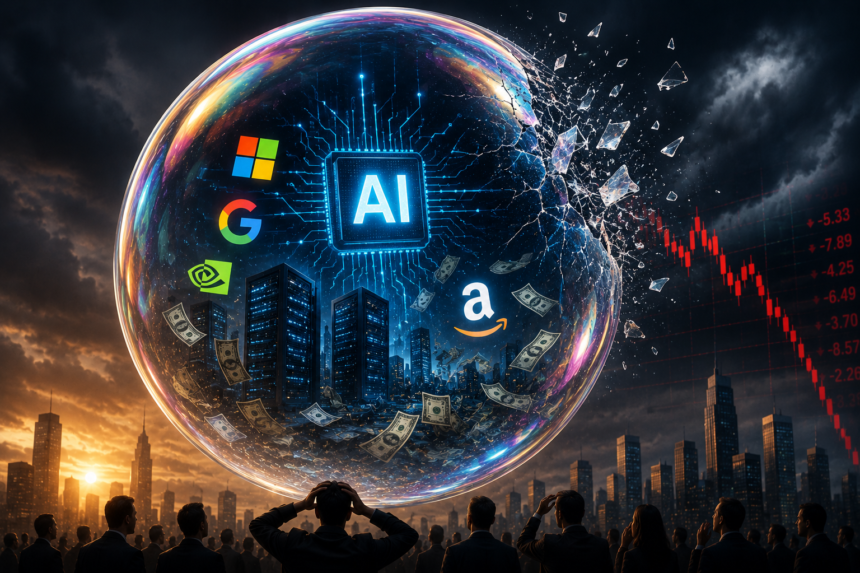
AI Gold Rush: Why Investors Are Spending at Historic Speed
Every generation believes its technological revolution is different. In the 1840s, it was the railway. In the 1990s, it was the internet and telecommunications. Today, it is Artificial Intelligence. The technology changes, the language evolves, and the companies leading the charge are new—but human behaviour often remains the same.
A breakthrough appears, early success sparks excitement, investors rush in, and companies fear being left behind. Money begins to move faster than the technology itself, and expectations grow beyond what can realistically be delivered in the short term. Eventually, reality arrives. Sometimes the entire idea collapses, but more often, investors lose billions while the technology quietly continues to reshape the world.
That is the question surrounding AI today: are we wisely investing in the next great revolution, or are we pouring enormous sums into a future we do not yet fully understand?
The scale of AI investment is no longer just impressive—it is historically significant. Goldman Sachs estimates that annual AI capital expenditure could reach around $765 billion by 2026 and climb to $1.6 trillion by 2031. Tech giants like Amazon, Microsoft, Alphabet, and Meta are collectively spending hundreds of billions on data centres, advanced chips, and AI infrastructure. According to Reuters, hyperscaler spending alone could hit $725 billion in 2026, nearly doubling projections from just a year earlier.



This surge is not limited to corporate cash; companies are issuing massive amounts of debt, and financial institutions are creating new funding models tied to AI infrastructure. In just a few years, AI has shifted from a research topic to one of the largest capital investment races in modern history.
From Research Labs to Balance Sheets
What stands out is not just the amount of money being spent, but the speed at which it is being deployed—often before key questions about profitability, demand, and long-term impact have been answered.



History offers striking parallels. During Britain’s Railway Mania in the 19th century, investors poured money into railway projects, convinced they represented the future—and they were right. At its peak, railway investment accounted for about 7% of the country’s GDP. However, speculation ran ahead of reality. Many projects were poorly planned, companies collapsed, and investors lost fortunes.
Yet the railway network remained, becoming a backbone of industrial growth. The lesson is clear: the bubble burst, but the technology endured. The same pattern appeared in the telecommunications boom of the 1990s. Companies invested over $500 billion in fibre-optic networks, expecting explosive demand for internet data. But infrastructure expanded faster than usage, leading to bankruptcies like WorldCom and Global Crossing.
Still, the networks built during that period later powered the digital economy we rely on today. Investors lost money, but the infrastructure proved invaluable.
The dot-com bubble followed a similar trajectory. By the late 1990s, investors were convinced the internet would transform business—and they were correct. However, that belief led to inflated valuations and unsustainable business models.



In 1999, the Nasdaq surged 86%, only to crash by around 77% over the next two years. Many companies disappeared, but the internet itself thrived. Survivors like Amazon and Google went on to dominate global markets. The lesson from all these episodes is consistent: being right about the future does not guarantee being right about timing or investment strategy.
AI today may be following the same path. It is already being widely adopted across industries, from software development and customer service to research and content creation. According to Stanford’s AI Index, 78% of organisations reported using AI in 2024, up from 55% the previous year. Investment in generative AI alone reached $33.9 billion in 2024.
Clearly, the technology is real and impactful. However, widespread use does not automatically justify the massive infrastructure spending underway. The key question remains whether businesses and consumers will generate enough revenue to support these investments.
Another powerful force driving this surge is fear. Corporate leaders have seen what happens to companies that miss major technological shifts. No CEO wants to be remembered as the one who ignored AI. This creates a situation where overinvestment becomes a rational strategy. The decision is no longer just about potential returns, but about survival. If competitors invest heavily and succeed, those who hesitate risk becoming irrelevant. However, when every major player adopts this mindset simultaneously, it can lead to excessive spending and inflated expectations.
Unlike previous technological waves, AI also raises deeper societal questions. It has the potential to reshape jobs, creativity, and decision-making in ways we are only beginning to understand. Meanwhile, the infrastructure supporting AI is consuming vast amounts of energy. The International Energy Agency estimates that global data centre electricity usage could more than double by 2030, largely driven by AI.
At the same time, governments are still debating regulations, schools are figuring out how to integrate AI into education, and industries are grappling with its impact on employment and intellectual property. In many ways, society is still trying to understand AI while the technology is already being built at massive scale.
So, will the AI bubble burst? It is certainly possible. But history suggests that even if it does, the technology itself will likely endure. If the pattern of railway mania repeats, today’s investments could leave behind infrastructure that powers future growth. If the telecom boom is the closer comparison, companies investing heavily now may struggle, while others benefit later from the systems they built. And if the dot-com era is the best parallel, many AI companies may disappear, leaving a few dominant players to shape the future.
Ultimately, history teaches us that investors often confuse being right about the future with being right about timing and valuation. Railways, telecommunications, and the internet all transformed the world, yet each wave also produced massive financial losses. AI could follow the same path. It may become the most important technology of our generation while still triggering a painful correction in the market. These outcomes are not contradictory—they are part of the same pattern.
As billions continue to flow into AI, the situation feels increasingly familiar. The technology may be new, but the excitement surrounding it is not. And if history is indeed preparing to repeat itself, the real question is no longer whether AI will change the world—it is who will survive the cost of building that future.