




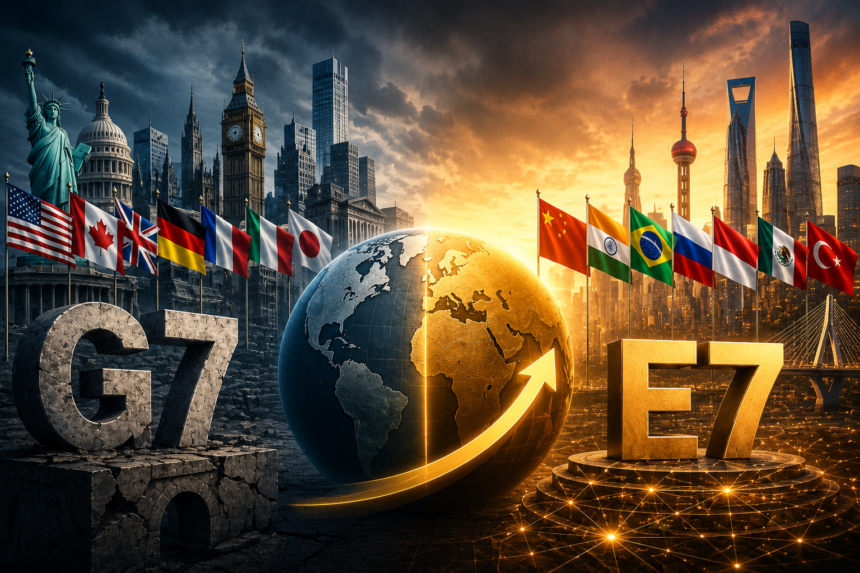
A bold prediction from a senior UAE minister has reignited a debate that economists, investors, and geopolitical strategists have been discussing for years: what if the future global order is no longer shaped by the traditional G7 economies, but by a new bloc of emerging economic powers known as the E7?
The statement “G7 will be replaced by E7” may sound dramatic. But beneath the headline lies a deeper reality: the center of global economic gravity has been gradually shifting away from the West and toward emerging markets for more than two decades.
What Is the E7?
The E7 refers to seven major emerging economies:
- China
- India
- Brazil
- Russia
- Indonesia
- Mexico
- Turkey
Unlike the G7, which consists of advanced industrial economies such as the United States, Japan, Germany, France, the United Kingdom, Italy, and Canada, the E7 represents countries with younger populations, expanding consumer markets, growing industrial bases, and increasing geopolitical influence.

For decades, the G7 dominated global trade, finance, technology, and policymaking. However, the rapid rise of Asian and emerging economies is beginning to challenge that dominance.
The Numbers Behind the Shift
The argument for an E7-led future is not merely political rhetoric.
India is now among the fastest-growing major economies in the world. China remains the world’s manufacturing powerhouse. Indonesia is emerging as a critical player in Southeast Asia. Brazil continues to dominate agricultural exports, while Turkey and Mexico occupy strategic positions in global supply chains.
According to multiple long-term economic forecasts from international institutions and consulting firms, the combined economic output of emerging economies is expected to surpass that of traditional developed nations over the coming decades.
Even today, the G7’s share of the global economy is significantly lower than it was in the 1980s, while emerging economies continue to increase their contribution to global GDP, trade, and consumption. The growing influence of blocs such as BRICS has further highlighted this transition.
Why Emerging Markets Are Gaining Ground
Several structural advantages are driving the rise of the E7:



Demographic Strength
Most G7 countries face aging populations and slower workforce growth.
In contrast, nations such as India and Indonesia possess young populations that can fuel economic expansion for decades through higher productivity, consumption, and entrepreneurship.
Manufacturing and Supply Chains
Global companies are increasingly diversifying manufacturing beyond traditional centers.
Countries like India, Mexico, Indonesia, and Turkey are benefiting from supply chain realignments as businesses seek alternatives and resilience in production networks.
Digital Leapfrogging
Many emerging economies are skipping traditional stages of development and moving directly into digital ecosystems.
India’s digital payments revolution, Indonesia’s fintech growth, and China’s AI and e-commerce dominance demonstrate how technology is accelerating economic transformation.
Rising Domestic Consumption
Unlike export-driven growth models of the past, emerging economies are increasingly powered by their own consumers.
As incomes rise, domestic demand creates a powerful engine for long-term growth.
Why the G7 Still Matters
Predictions about the “end” of the G7 should be approached carefully.
The G7 continues to control a substantial share of global wealth, financial institutions, technological innovation, and geopolitical influence. Together, G7 nations still account for a significant portion of global GDP and remain central to international decision-making on finance, security, climate policy, and technology regulation.
The United States remains the world’s largest economy. Germany and Japan continue to be industrial and technological giants. Financial centers such as New York and London still dominate global capital flows.
The more likely scenario is not the complete replacement of the G7, but the emergence of a more balanced global order where economic influence is shared between developed and emerging powers.
The UAE’s Strategic Perspective
The UAE’s interest in an E7 future is understandable.
Located at the crossroads of Asia, Africa, and Europe, the UAE has increasingly positioned itself as a bridge between emerging markets and developed economies. Its investments, trade relationships, and diplomatic engagements reflect a world where economic power is becoming more distributed.
For Gulf nations, the rise of Asia and emerging economies presents significant opportunities in trade, logistics, energy transition, technology, and investment.
What This Means for India
For India, the E7 conversation is particularly significant.
India is no longer viewed merely as a large market. It is increasingly seen as a potential pillar of the next global economic architecture. Manufacturing expansion, infrastructure development, digital innovation, startup growth, and geopolitical positioning have strengthened India’s role in global discussions.
If the 20th century belonged largely to the Western industrial economies, the coming decades may increasingly be shaped by countries that combine scale, demographics, technology adoption, and economic ambition.
The real question is no longer whether emerging economies will gain influence.
The question is how quickly they will reshape the institutions, alliances, and economic rules that have governed the world for the last half-century.
As global power shifts eastward and southward, the future may not be about the G7 versus the E7. It may be about a world where emerging economies become equal architects of the global order.